



.png)



Most students don’t just wake up one day knowing they want to be a doctor. Like a lot of high schoolers, your interest may have sparked during a biology unit, or a volunteer experience, or a particularly inspiring episode of The Pitt. At some point, you started thinking medicine might be your thing, but you’re not quite sure.
The path to medicine is long, demanding, and expensive. It’s important to know what a career in medicine actually looks like before you commit. Most pre-med advisors agree that high school is the best time to explore your interest through shadowing or structured programs.
If you’re a teen interested in medicine, you may have heard about summer programs like Outset where you can learn about medical careers. There are many programs like Outset, and it can be hard to figure out which ones are the best for you.
If you’re overwhelmed, you’ve come to the right place! We’ve done the research and summarization for you below to identify the 10 Best Summer Programs for Teens Exploring Medicine in summer 2026. We have summarized all these programs by their cost and other key factors to help you consider and evaluate options. We hope this guide will help you navigate the best summer medical programs in the United States and find the best fit for you.
First Things First: Do You Need to Pay for a Summer Medical Program?
Good question! The answer is very clear: you do not need a paid program to explore medicine or gain meaningful experience in high school. There are many free or low cost options that can help you get exposure to the medical field and evaluate if it’s a good fit for you. Below are a few ideas to consider:
- Shadow medical professionals at a clinic or hospital.
Even a few hours shadowing nurses, techs, or doctors across specialties can clarify what you like, and what you don’t. Many hospitals or clinics have shadowing programs - often you do have to apply but with persistence you can get in!
- Find healthcare-related volunteer opportunities.
Contact hospitals, clinics, or charities to find opportunities that genuinely interest you. Even nursing homes are a great option for volunteering! You can gain insight into community health challenges and make a meaningful impact. You may need to be 16+
- Get hands-on first responder skills.
High school students usually can’t be certified EMTs, but you can learn emergency skills through CPR, first aid, or a local junior responder program.
- Conduct research at a local university or research lab.
Find a lab in a field you’re passionate about, like biology, neuroscience, or public health. Ask how you can contribute through a summer project.
- Join a local HOSA Future Health Professionals chapter.
HOSA is a national organization that gives you access to workshops, competitions, leadership opportunities, and other valuable resources if you’re a teen interested in medicine. It’s also a great way to meet like-minded peers!
When to Consider a Teen Medicine Program
Free and low-cost options are great options as you begin your pre-med journey. However, a pre-college medicine summer program may be worth the investment depending on your goals. Here are common scenarios where it makes sense to invest:
- You want a structured curriculum.
Medicine is a vast and complex field. How do you explore multiple specialties, learn key skills, and progress your learning? Many students prefer a structured introduction to medicine instead of piecing together volunteer work or shadowing. A pre-med teen summer program like Outset offers a guided path with practical skills and experiences.
- You value direct mentorship from medical professionals.
Mentors play a critical role in helping students determine if medicine is the right path. They can get to know you and your goals, share career experiences, and point you to valuable resources.
Most medical professionals are busy. Hospitals have strict access rules, and you aren’t likely to have meaningful interactions with the attending physicians. Summer programs create intentional mentorship through small-group discussions with physicians, guidance from medical students, and instructors who want to teach and support teens.
- You want to get hands-on skills or experience.
Some students thrive in hands-on, fast-paced environments. Shadowing is observational. Research is slow. Volunteering may keep you far from anything clinical. Pre-med summer programs often provide hands-on opportunities that are rare to come across elsewhere. For example, at Outset you might choose between specialties like pediatrics, surgery, emergency medicine, or nursing. You could practice clinical skills in simulation labs, complete suturing workshops, learn how to read imaging, take vitals, or run mock patient scenarios.
- You want to build friendships with like-minded peers from across the USA.
For students who value community, summer programs offer more than academics and career exploration. They provide the chance to meet peers with similar interests, form meaningful connections, and bond through group activities, hands-on projects, and campus life in the dorms. After all, summer is supposed to be a little fun!
- You don’t have access to local medical opportunities.
Shadowing, research, and community work sound great, but can be really difficult to find in practice. Hospitals may not allow high school volunteers. Not all research labs accept teens. Cold emails go unanswered. You might be feeling stuck.
Pre-med summer programs can help tackle this barrier to entry and offer driven students a meaningful opportunity to test-drive a career in medicine before they’re all in.
How Much Do Selectivity and Prestige Matter?
We get it. Everything feels like it leads back to the college application. But to be honest, a summer program is unlikely to make or break your college application. Your grades, references, test scores, and personal statement matter most.
What these programs can do is clarify your academic interests, sharpen your narrative, and provide concrete stories and insights you can articulate in interviews and essays. Selectivity and brand name isn’t a substitute for meaningful engagement. In other words, it’s more about what you do there that counts.
Colleges aren’t looking for students who simply checked a competitive program off their list. They’re looking for students who show genuine curiosity, passion, and growth.
Note: some teen medicine programs below are more competitive than others. For example, Outset programs are known for a serious Admissions process, GPA requirements, and teacher references.
What to Know About Cost & Financial Aid
Teen summer programs can be expensive! They vary in cost, from free options like Baylor College of Medicine to full-cost programs like Penn Medicine ($11,255). We have the full list below.
Some programs offer financial aid and scholarships. Outset, Georgetown, Wake Forest, Brown, and Johns Hopkins (among others) provide need-based awards, though availability for scholarships varies by program. For all these programs, families will need to inquire directly to understand their options.
The key is applying early. Financial aid is often limited and runs out, so you’ll want to secure funding earlier in the application cycle. If affordability is a priority for your family, we’ll also highlight several free or low-cost program options below.
How Did We Select These Programs?
We focused this guide on the programs that students come across most frequently when researching medical summer experiences. These programs are all commonly found in Top Medical Summer Program lists, college advising circles, and online forums. We also did our own research and spoke with various experts in the field about which programs are popular today.
Given that a “teen medical program” can mean very different things, we curated a diverse list to represent the full landscape of possible experiences. Some emphasize lectures on campus, others lean into research, and still others offer hands-on clinical exposure. The depth, structure, and day-to-day experiences at each program can vary widely. Comparing these opportunities side-by-side will help you clarify what works best for your unique learning style.
Quick Comparison: The Top-10 Teen Summer Medicine Programs at a Glance
We wanted to put together a handy visual resource if you’re trying to identify which program is right for you! Check out our at-a-glance overview of top summer medical programs for high school students:
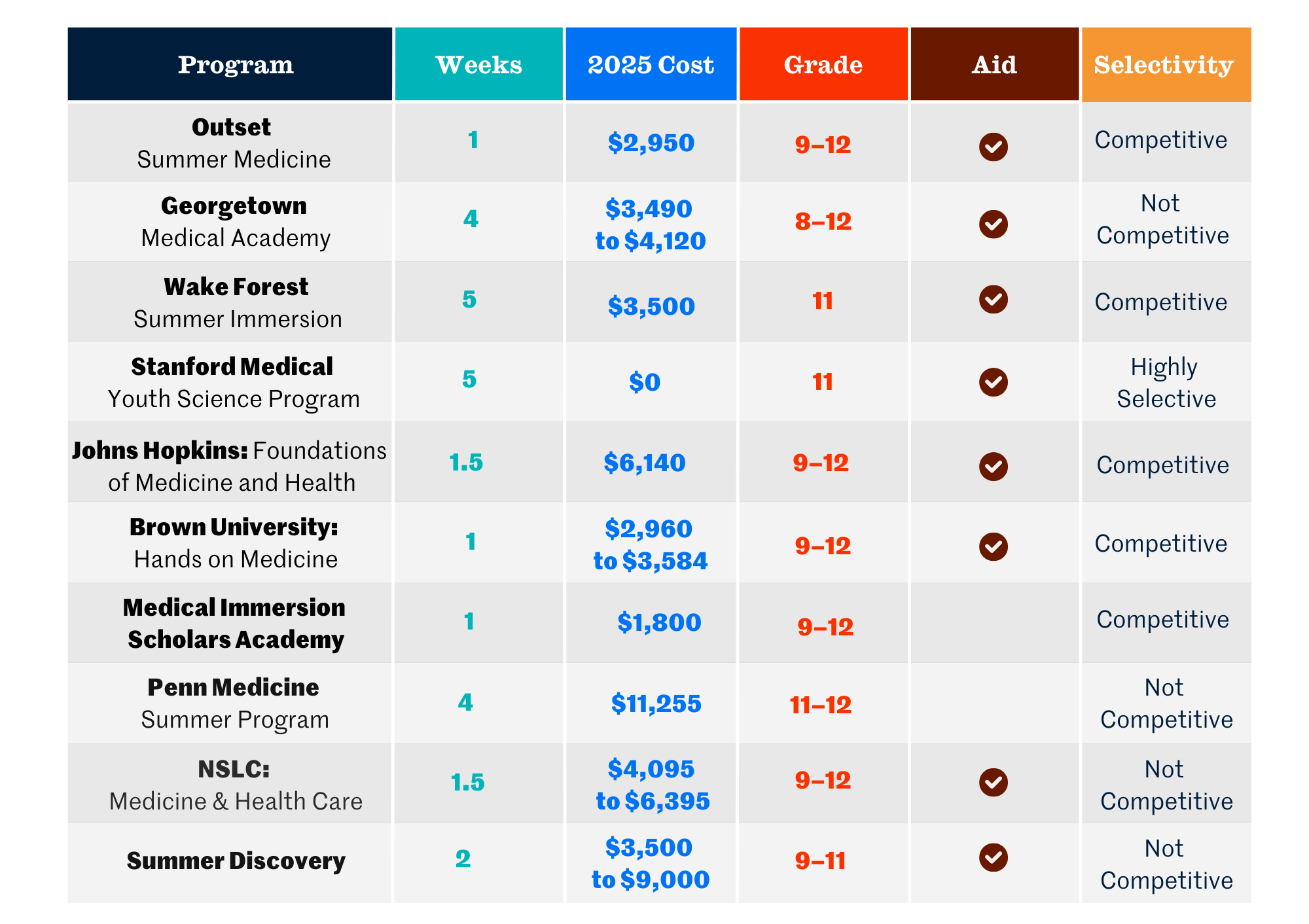
The 10 Best Summer Programs for High School Students Interested in Medicine
Here is our list of the top 10 pre-med summer programs.
- Outset Teen Medicine Program
Outset is America’s leading summer program option for High School Students (9th-12th grades) exploring Medical Careers. They have a very experienced leadership team and are the only program on the list exclusively focused on healthcare. Outset also has great reviews.
For teens who are exploring a career in medicine and want hands-on experience, the 1-week Outset programs offer a unique opportunity to dive into a medical specialty. You can spend the week exploring fields like: Nursing, General Surgery, Cardiology, Family Medicine, Pediatrics, Dentistry, Dermatology, Orthopedic Surgery, Anesthesiology, or Neurosurgery.
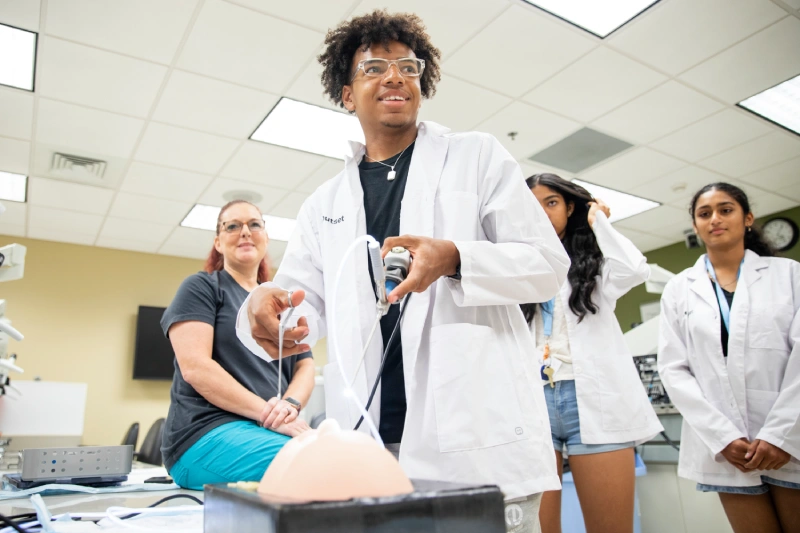
Physician mentors at Outset will guide you through hands-on skills specific to your specialty, like cardiac ultrasound imaging, drilling on bone models, or suturing techniques, and share their insights so you can see what a day in the life might look like. You’ll also leave with practical guidance on how to thrive as a pre-med student once you get to college.
Like many programs, at Outset you will live on a college campus and get a taste of campus life with your peers, from staying in the student dorms to eating at campus dining halls. Locations for Outset include UCLA, UNC Chapel Hill, Columbia, University of Michigan, Vanderbilt, and Arizona State University, and there will be programs in Texas, Florida, and Washington soon.
The program costs $2,950, but financial aid is available for students who demonstrate financial need. Students in grades 9–12 can participate. The program is competitive and you are required to go through an Admissions process to ensure you are a good fit for the program.
- Georgetown Medical Academy
Spend a week exploring a wide range of medical topics at Georgetown Medical Academy through a mix of lectures, interactive experiences, guest speakers, and group discussions. You’ll dive into subject areas such as patient care, surgery, ICU medicine, and biomedical ethics.
Guided by experienced professionals, you’ll practice essential medical skills, from assessing heart sounds and applying casts to examining human organs, gaining a hands-on understanding of what it takes to work in medicine.
You can choose to attend as a residential or commuter participant on Georgetown’s campus. Tuition ranges from $3,500 to over $4,000 based on your program and residential choice, and need-based financial aid is available. Open to students ages 15–18, the program has a straightforward application process that assesses basic eligibility requirements.
- Wake Forest University Summer Immersion: Medicine Institute
If you’re just starting out and want to explore broadly before narrowing your focus, Wake Forest’s Summer Immersion: Medicine Institute is a good place to start. You’ll explore a variety of medical disciplines and enjoy immersive sessions such as touring the Wake Forest School of Medicine, interviewing standardized patients, and exploring the latest medical technology advances in the cardiac cath lab.
You’ll get the full campus experience during this five day program as you live with other students on the Reynolda Campus. Tuition is $3,500, and financial aid options are available for those who qualify. If you want to apply, the program is selective, requiring essays, recommendations, and academic records.
- Stanford Medical Youth Science Program (Free)
For current high school juniors in Northern California, the Stanford Medical Youth Science Program offers an intensive five-week deep dive into medicine and biomedical research.
This highly selective program immerses students in faculty lectures, professional development workshops, in-depth labs, an internship at Stanford Hospital, and a public health disparities research project. You’ll benefit from strong mentorship and a supportive, small cohort, developing your skills and confidence to reach your full potential in college and beyond.
SMYSP is commuter-based, tuition-free for those selected. The program accepts only 24 scholarship recipients each year.
- Johns Hopkins University: Foundations of Medicine and Health
The Foundations of Health and Medicine course at Johns Hopkins University offers the unique opportunity to earn one academic credit as you explore courses such as Introduction to Surgery and Medical School Intensive.
Through daily modules that combine lecture content and interactive activities, you’ll gain a broad understanding of surgery, internal medicine, pediatrics, emergency medicine, and biomedical science. Hands-on labs, including a fetal pig dissection, allow you to apply your knowledge in practical ways.
Students can choose to participate in the residential program at the Homewood campus for a fully immersive experience (costing $6,140 for the nine-day experience), or opt for online courses that can be completed at your own pace. Admissions involve a standard application process.
- Brown University Pre-College Summer Program: Hands on Medicine
Step into the shoes of a medical student and see what a typical week in medical school is really like at Brown University’s Hands on Medicine program.
Guided by current medical students, you’ll explore the day-to-day life of a medical student at the Warren Alpert Medical School through a combination of classroom lessons, clinical skills sessions, and interactions with standardized patients. Build your understanding of human physiology and anatomy, and put it into practice by performing physical exams and patient interviews.
This five-day program is designed for students in grades 9–12 and is offered in both residential and commuter formats. Tuition is around $3,500 for residential programs, with additional costs for transportation, meals off-campus, and personal expenses. Admission is selective and application-based.
- Medical Immersion Scholars Academy
For students who want hands-on experience in healthcare and the opportunity to earn recognized credentials, the Medical Immersion Scholars Academy offers a unique five-day program in Oakland, CA. Participants engage in clinical simulations, phlebotomy training, and collaborative exercises, benefiting from a “learning by doing” approach that reinforces each skill through active application.
Each week, you’ll earn health-focused certifications, providing real credentials in effective communication, active listening, and teamwork. This combination of practice and certification prepares you for success in future healthcare environments.
This program is open to high school students in grades 9–12 and is commuter-based. Tuition is $1,800, and admission is selective, determined through an application and interview process.
- Penn Medicine Summer Program
If you’re looking for a full-summer academic experience across a range of medical topics, Penn Medicine Summer Program offers a 4-week intensive curriculum modeled after a first-year medical school curriculum.
Outside of lecture, you’ll learn core skills like CPR and first aid, practice suturing and surgical knot-tying, and take part in labs such as gross anatomy or microbiology. Students also observe a live or simulated surgery and learn directly from Penn physicians across multiple specialties.
You’ll live on campus at the University of Pennsylvania throughout the program. Tuition is $11,000 or more, and admission is somewhat competitive, requiring an application, essay, and recommendations.
Applicants must be entering grade 11 or 12 in September 2026 and have completed a high school level biology class prior to the start date.
- Summer Discovery
A good option for students seeking broad exposure to general medicine is Summer Discovery. Over the two to three week program, you’ll be introduced to a variety of medical careers, like Pediatrics, Family Medicine, OB/GYN, Nursing, Plastic Surgery, Emergency Medicine, Dentistry, and Research. You can choose to live on campus or commute, depending on your preference. Campuses include UC Berkeley, University of Michigan, Georgetown, and UCLA.
Tuition can be quite expensive - program fees range from $3,500 to $9,000 based on your choice of campus. Financial aid is available. The program is open to students currently in grades 9–11. You will need to submit a standard application to be considered to attend this program but Admissions to this program is not competitive.
- NSLC: Medicine & Health Care
For students who want to grow their leadership skills, NSLC’s Medicine & Health Care program is a unique option. Over nine days, you’ll learn about a variety of healthcare careers and leadership. Alongside learning medicine, you’ll join workshops focused on personality styles, communication and listening, resilience, and empathy, helping you discover what it takes to create a positive impact in healthcare.
This program is offered at universities like American University, Duke or the University of British Columbia. Get the full college experience with dorm life, campus dining, and evening activities.
Tuition ranges from $4,000 to $6,500 or more with extra fees, but NSLC does award scholarships each year to help make it more accessible. This program is open to all high school students in grades 9–12. Students must be admitted to the program, but Admissions is not competitive.
Final Thoughts
So there you have it: 10 excellent summer medical programs for high school students interested in medicine.
As you decide which is the best fit, reflect on your personal goals, budget, and learning style. Consider whether you want a broad overview of medicine or deep immersion in a specialty, whether your focus is academic learning, hands-on skills, or mentorship, and if a residential experience is important to you.
The best summer program will challenge you, inspire growth, and help you discover more about yourself and your potential future path in medicine.



%202.jpg)